
Note 05 · four faces
Veneer, solid wood, laminate, and foil
The face of a cabinet can be a thin sheet of wood, a thick piece of wood, a hard resin sheet, or a printed film. They fail in different places. The edge is where you look first.
Published · Updated
01 · VENEER
A thin wood face
Veneer is real wood, sliced thin and glued to a ground. The ground may be a stable board, a cheaper timber, or a frame. At a chipped corner you may see a line: a thin layer of one colour over a thicker layer of another. The grain on the face usually shifts as you move along it. Two doors can be book-matched, so a mirror image is not proof of a print.
A repeating pore that is identical every few centimetres, and that does not turn the corner onto the edge, is more often a print. Real veneer grain rarely stamps itself like wallpaper. Heat and long steam can soften the glue under a veneer. A radiator hard against a door, or a kettle under a shelf, is a common way blisters start. This page does not describe ironing a blister flat. Household heat is how many blisters are made.
02 · SOLID
The same wood through
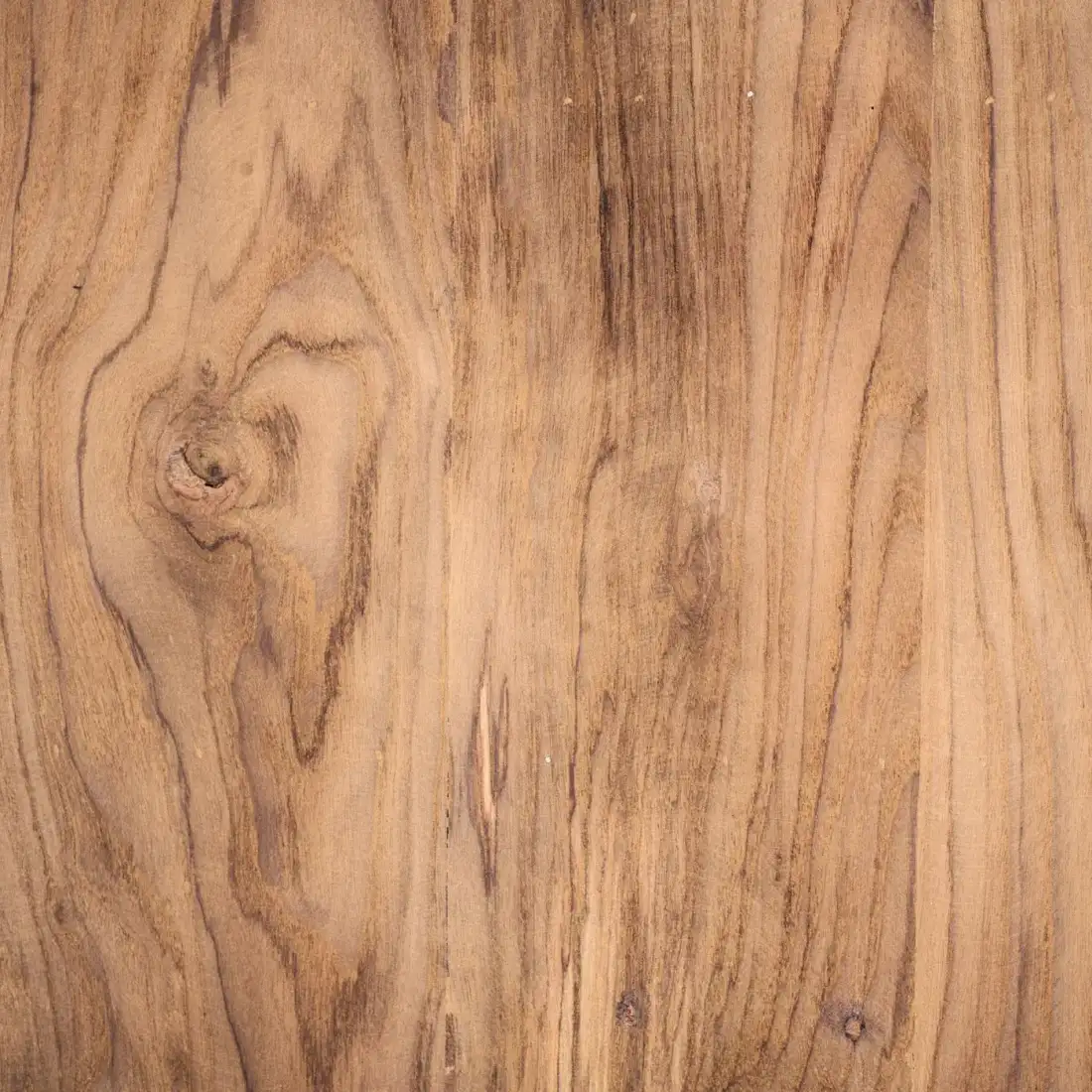
On solid timber the grain at the edge is the end or side of the same piece you see on the face. There is no sudden change to a pale chipboard core. End grain looks more open and drinks a finish differently, which is why the ends of a solid top often darken or dry out first. Solid wood moves across the grain, which is the subject of the timber movement note. A veneered board moves much less as a panel, but the veneer itself can still split if the ground bends or the glue lets go.
03 · LAMINATE
A hard sheet
High-pressure laminate is a resin sheet, not wood, even when the print shows pores. It is tough on a face and brittle at an edge. Chips are sharp and pale or dark in a layer that does not look like fibres. You cannot sand a laminate print back to fresh grain, because there is no grain under the picture. A chip is a missing piece of sheet. Moisture that gets under a lifted edge can swell the board beneath, and the swell does not go back when the surface dries. That swollen core is often the real problem, with the laminate only telling you where water entered.
04 · FOIL AND PAPER
A printed skin
Foil, paper, and thin vinyl wraps are common on modern doors. The print can be convincing until a corner wears through to a uniform board. Edge tape, a strip of plastic or wood-grain tape, is a separate piece. When the tape lifts, the core shows as a line along the door, not as a chip in the middle of the face. Heat from an oven or a radiator softens some tapes. The light and heat note is the companion page if the door sits in a hot run of cabinets.
What to record before anyone colours a chip
Photograph the chip and the edge in the same session, in daylight if you can, without a strong filter. Note whether the pattern repeats like a stamp. Say if the piece lives over a heater. Colour that is touched onto a chip in a film or a foil rarely disappears into the print, because the print has a regular pore and the brush mark does not. On veneer, a new flake of wood can be closer, and still visible in raking light. The surface wear note explains that light.
If the core has swollen, no surface colour will make the door flat. If you are describing the piece to someone else, say “swollen core” or “lifted tape” rather than “scratched wood” when that is what the edge shows. All eight notes are listed in the catalogue.